
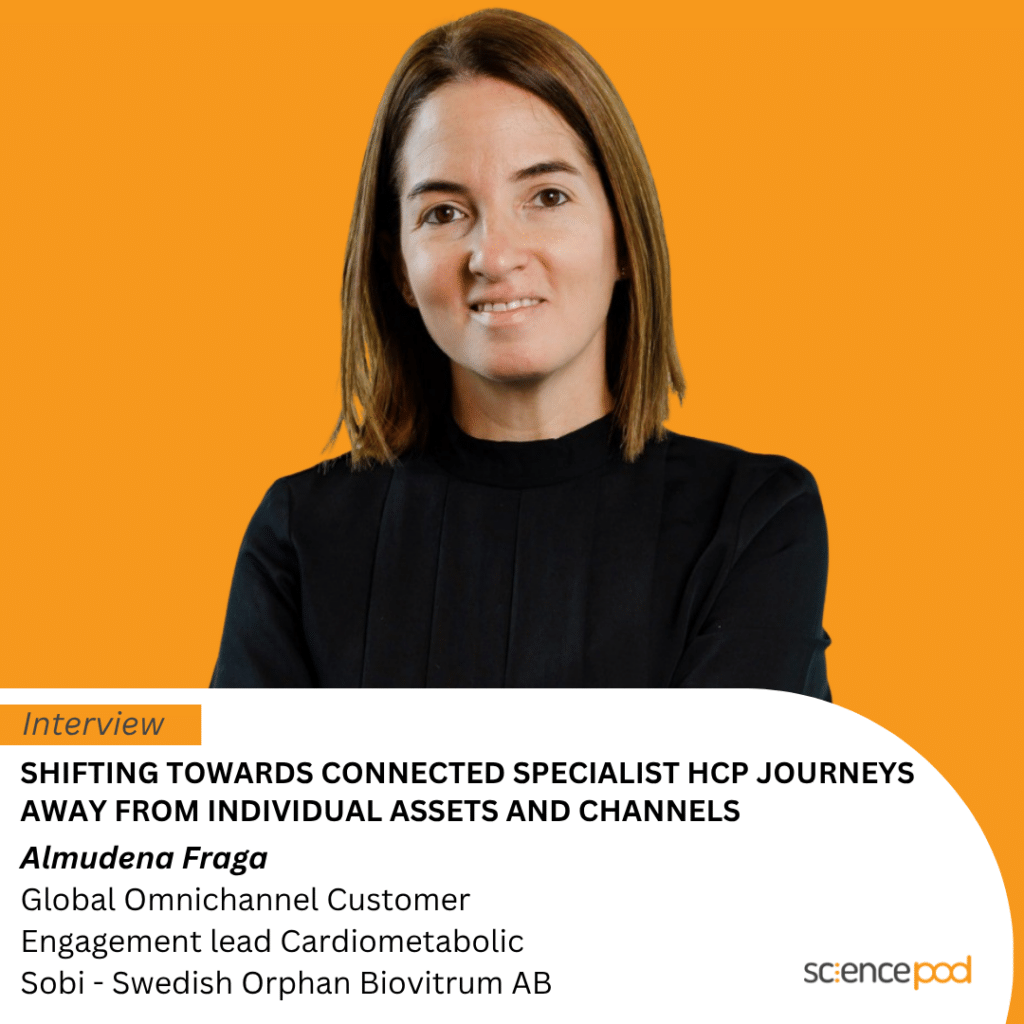
Interview with Almudena Fraga, Global Omnichannel Customer Engagement Lead Cardiometabolic, Sobi
“In cardiometabolic, where HCPs are exposed to a high volume of information and competition for attention is intense, relying on reps and MSLs alone will not help us standing out from the crowd.”
— Almudena Fraga
In this exclusive interview, connected customer experiences take centre stage. Almudena shares her insights with SciencePOD CEO Sabine Louët, exploring how digital channels complement face-to-face interactions with MSLs and reps.
Fraga shares her views ahead of the Oxford Debate: Should Pharma Stop Visiting HCPs? at the NEXT Pharma CX & AI conference, on 27 and 28 October in Vienna. Fraga was due to appear (but was unable to attend) with Andew Binns, Director of Poke Marketing, and debate moderator Yacin Marzouki, omnichannel pharma advisor at Biond health.
What is your role at Sobi?
I am the global omnichannel customer engagement lead for Cardiometabolic. My role is to help translate brand strategy into connected customer experiences, bringing together field, medical and digital engagement, content and data. I work closely with global and local teams to build omnichannel customer engagement capabilities in Sobi’s new cardiometabolic therapeutic area.
Where do you see the role of digital engagement compared with relying on reps and MSLs?
In cardiometabolic, where healthcare professionals are exposed to a high volume of information and competition for attention is intense, relying on reps and MSLs alone will not help us stand out from the crowd.
Digital engagement helps us extend those valuable human interactions across a much broader and more diverse group of healthcare professionals in a tailored manner, while keeping the conversation relevant over time.
A face-to-face conversation should not have to start from zero or end when the visit finishes. For example, an HCP might attend a disease-awareness webinar and express interest in a particular topic. Where appropriate and with the necessary permissions, that can help inform a more relevant follow-up conversation with a rep or MSL, within their respective roles. Afterwards, relevant digital content can reinforce the discussion and help the HCP explore the topic further. It is about continuity, not simply adding another touchpoint.
How does digital engagement allow more personalisation than traditional approaches?
Traditional engagement can leave gaps: specialists outside established visit plans, those in geographically dispersed settings, or HCPs who have limited availability for in-person meetings. Some also prefer to access information independently, at a time that suits them.
Digital gives us additional ways to reach and connect with these audiences through relevant professional platforms, scientific webinars and on-demand content – in a personalised manner. We tend to refer to HCPs as being the same, having a parity of interests and needs. Evidence shows that’s not the case, some prescribe, some advocate, some refer. The conversation should be tailored and digital enables and facilitates this approach.
What has been your proudest achievement to date in HCP digital engagement and why?
One achievement I’m particularly proud of is helping shift the conversation from individual digital assets and channels to connected HCP journeys differentiated by specialist. So we don’t speak about HCPs as a whole, transforming the way we engage with customers.
The starting point should be the specialist’s clinical context and information needs, not simply their specialty label. These are all relevant: Their role in the patient journey; their approach to therapies and patients; their prescription barriers, drivers and their emotional triggers.
In cardiometabolic care, for example, a cardiologist’s journey might be completely different to an endocrinologist journey. The second could benefit from concise educational content and opportunities for discussion; the first might prioritise deeper evidence and scientific exchange. We should then refine those journeys based on individual needs and engagement, rather than assuming everyone within a specialty is the same.
How critical is the choice of channel in your customer engagement mix, and what would be your priority channels?
Channel choice is critical, but it should come after understanding the customer, the need and the behaviour we want to support. The narrative should feed the channels, not the other way around.
There is no single priority channel for every healthcare professional or every moment. Face-to-face engagement remains important, particularly for high-value and scientific discussions, while digital touchpoints can extend reach and continue the conversation.
The priority is the right mix and sequence for each audience. A webinar could examine the evidence in more depth, while an MSL conversation could address specific scientific questions.
Where do you see the future of HCP engagement?
I see future engagements based on precision engagements, enabled by data and AI. The connection, personalisation and seamless experience will be a consequence of that. The omnichannel marketing becoming the next level of personalisation. Maybe less quantity and more quality. Lots of efficiencies for teams and process streamline.