
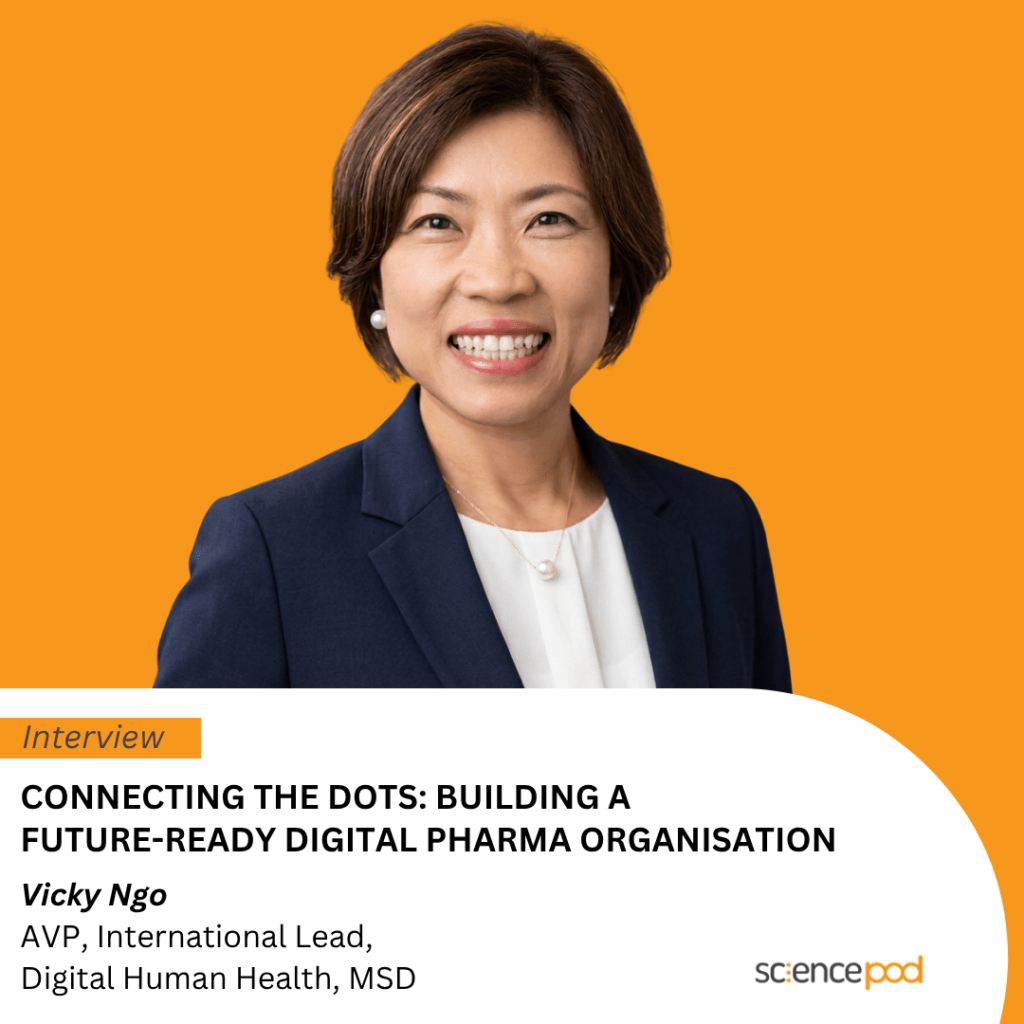
Interview with Vicky Ngo, AVP, International Lead, Digital Human Health, MSD
“It’s not just about the technology. It’s about the process and the people: redesigning how we work within the commercial team and how we connect with cross-functional teams like medical and others to better serve customers and patients”
— Vicky Ngo
What does it take to move beyond technology and transform how people, processes and data work together?
In this interview, Ngo explains how she is connecting the dots across the pharma value chain and between global and local markets to prepare for the future and make a difference for patients.
Ngo will be speaking on the panel ‘Building the data foundation that powers AI-driven content at scale’ at Reuters Events’ Pharma Commercial Data & Tech in London on 4-5 November 2026.
You are the International Lead of Digital Human Health at MSD in Zurich, Switzerland, tell us a bit about your role?
Human Health is our commercial organisation and in Digital Human Health we focus on sales and marketing, market access, and the commercialisation process. But I also have opportunity to work with manufacturing, R&D, and medical – to connect the dots across the pharma value chain.
My background is in digital and technology. I’ve worked in North America, Asia, and Europe, but MSD is my first experience in pharma. Tech, banking and consulting move very fast in digital, so I bring an outside–in perspective to digital transformation.
Can you share a digital transformation example that you are particularly proud of?
At the international level, I’m working on integrating the commercial digital backbone, frictionless data flows, and people to get us ready to connect technology and AI advancements in a way that complements launches and drives our business priorities. It’s not only about getting the product out, but also about getting the best real-world evidence to our customers.
We have new launches coming and we are really looking at personalised medicine. This has completely changed our thinking. We need to look closely at the patient journey and how we work with R&D, manufacturing, and commercial teams. Supporting a conventional launch is very different from supporting a personalised medicine launch.
We already have great tools like AI, but it’s not just about the technology. It’s about the process and the people: redesigning how we work within the commercial team and how we connect with other cross-functional teams like medical.
Real-world evidence has become increasingly important. What is going to be the real-world evidence that differentiates us in a particular market? Evidence-based promotion will become more important than a traditional engagement piece.
On that point, do you have any specific views on how content can serve that purpose?
We are double clicking on how the commercial organisation works with medical and how we conduct medical–legal review. The key question is: How do we make our content relevant to HCPs and our customers? Our processes will need to evolve. I envision earlier involvement of medical in planning. Medical and legal review will go first, rather than changing content every time afterwards. We are redefining the whole process to make it faster.
The technologies and AI available to us are available to every pharma company. What is going to drive our competitive advantage is how we break down silos and shorten time to market. It’s about redefining processes to ensure our data is right and in the central platform ready for AI consumption.
It’s not about deploying AI, it’s how people work together and how they work with AI. Without clarifying this, it creates a lot of fear and confusion. Change management and how people and AI work as a team will become very important. Early adopters can become the change catalyst on the ground, helping people understand what AI can and cannot do, and highlighting the human in the loop.
We also need to look at how we can use AI to engage with external stakeholders. This can be complicated, as you can imagine. It involves compliance, regulatory, safety, data privacy and ethical considerations. It involves thinking about what governance looks like in the future, how it’s evolving. And all of this needs to be considered in different local contexts: local markets, regulations, culture.
That’s interesting. And you have an internal mechanism to address these things?
Yes. One of our priorities is creating an environment where markets can learn from each other while maintaining the flexibility to innovate locally. Some of the most valuable ideas often emerge closest to customers, so we want to enable experimentation, share learnings across markets, and scale what works.
The newer generation of HCPs and patients consume information differently, so we are adapting to this. The global team is thinking broadly, and the market side is taking an innovative approach to sharpen local competitive advantages. What we are looking for is what brings great value to patients. The guiding questions are: Are we helping the organisation get ready for the future and are we making a difference for the patient.