
Episode seven of Pharma Decrypted goes back to first principles: know your audience. Host Sabine Louët, founder of SciencePOD, was joined by Ben Harbour, VP at Across Health, a consultancy sitting on a substantial body of proprietary data on how healthcare professionals actually engage. The conversation started from a problem Louët has been working on whilst building ScioWire – the personalised news feed for digital-native HCPs.
Here are the key takeaways from the conversation.
1. Pharma consistently misjudge their own channels
Harbour ran a test with pharma audiences, asking marketing and medical teams to estimate the relative impact of digital channels against face-to-face contact. The answer came back the same way every time: Pharma overcompensates for face-to-face and underrates digital. When looking at the data, he shows them the reverse is usually true.
Across Health measures performance rather than preference, on two indices. Reach asks whether a physician encountered a channel in the last three months. Impact scores from zero to ten what effect it had on a clinical decision. When plotted across promotional, medical, paid and earned channels, the result maps how the ecosystem actually works rather than how teams assume it does. What moves over time is mostly reach, while impact scores stay relatively stable.
The same gap between assumption and evidence shows up too when looking at different digital formats. When asked which digital formats they prefer to see from pharma, physicians put visuals, illustrations and charts well clear of everything else.

2. Relevance beats everything else
Among the many content attributes Across Health tracks, one comes top in every region they track: the relevance to my practice. It outranks trustworthy, balanced, clear and concise, and fresh and new.
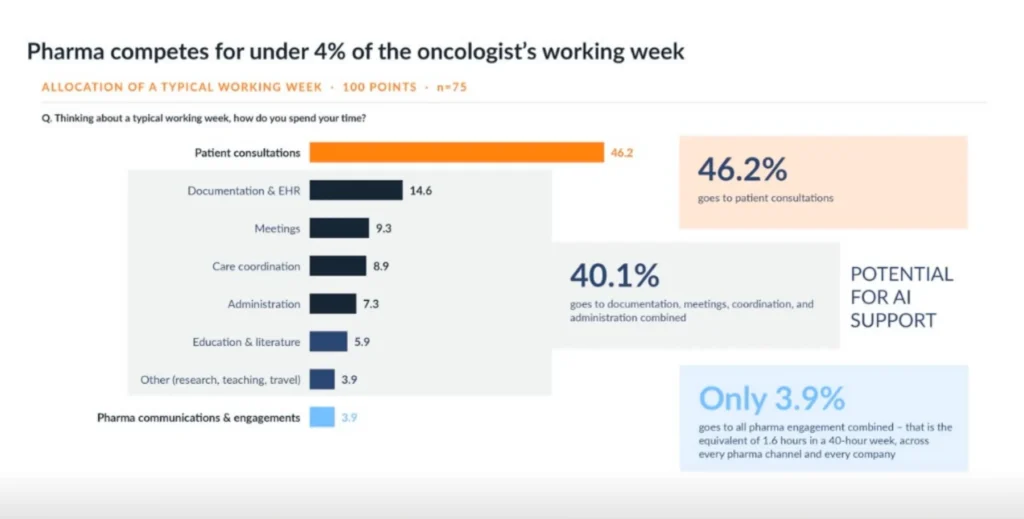
The reason? Arithmetic. On average, pharma communications and engagement take 3.9 per cent of an oncologist’s working week. That’s only the equivalent of 1.6 hours in forty, across every pharma channel and every company. Patient consultations take 46.2 per cent, and documentation, meetings, care coordination and administration take 40.1 per cent between them.
Guidelines show the other side of it. Of the fifty-plus channels Across Health measures, guidelines are the highest reaching, the highest impacting and the most trusted, which Harbour called the “north star” of all channels.
Nearly 70 per cent of physicians said they would give a pharma company more time and attention if it approached them in a more personalised way. Louët noted this echoes a Graphite Digital survey from earlier this year, which identified relevance, usefulness and usability as the criteria determining physician satisfaction.
3. Clinical data first, in a format that reads fast
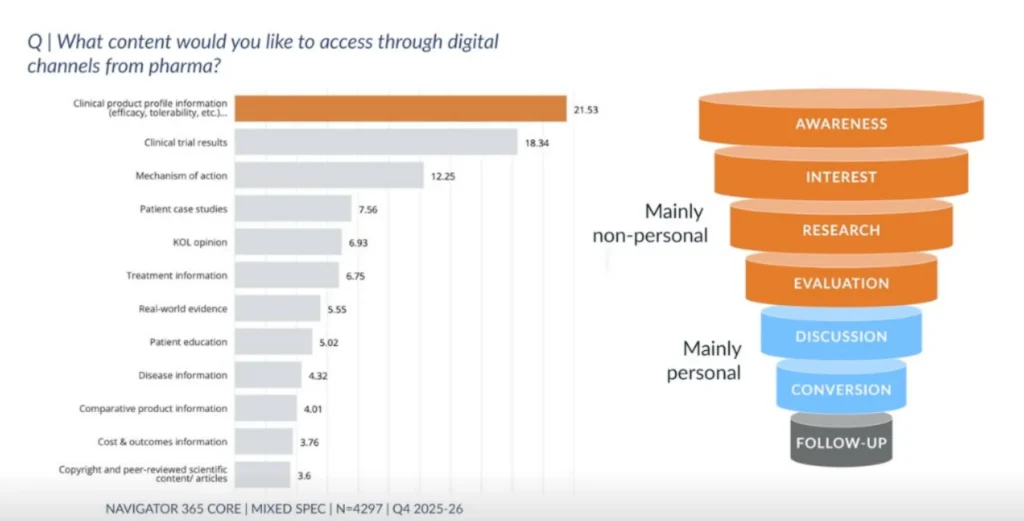
Asked what they want through digital channels, physicians put clinical product profile information at the top, covering efficacy, tolerability and safety, ahead of clinical trial results and mechanism of action.
Harbour’s reading is that digital does the heavy lifting at the top of the funnel. Awareness, interest, research and evaluation can all run through non-personal channels. The prescribing conversation still tends to happen face-to-face, though he expects digital and AI to take an increasing share of everything above it.
The format ranking follows the same time pressure. Medical content grows exponentially, as a PubMed search on any topic shows, and physicians are overwhelmed by the volume they would need to read to decide well for their next patient. The surprise is what comes second: PowerPoint slides. Harbour called them the digital equivalent of the free pen at a congress. Physicians train peers and run departmental webinars constantly, so slides they can take and reuse carry real value. His advice was to let them download yours.
Plain text sits third, notable given that around 70 per cent of HCPs are now digital natives. The paper has not been displaced, it has been repositioned. Make the quick version genuinely quick, then give the route onward through a QR code or a link. The same logic governs websites, where three things matter to physicians: the next educational event, a fast route to a human, and access to a paper.
4. The generation gap is narrower than assumed
Harbour pulled twelve months of data on European specialists and split it by age, comparing what he called the “Robert Downey Juniors” against the “Billie Eilishes”.

On channel exposure, age made no difference at all. Younger and older specialists encounter the same channels in the same proportions, across promotional, medical, paid and earned. Campaign planning does not need to segment exposure by generation.
The differences appear in how they want to be engaged. For non-promotional educational content, roughly three quarters of younger physicians want a mix of online and offline, with around a quarter preferring digital only. For promotional conversations, specialists over sixty lean towards face-to-face, with rep reach around 80 per cent over three months. Among under-thirties, 63 per cent rated digital as important.
Louët connected this to ScioWire. A personalised feed built for the digital-native cohort addresses the group most receptive to a digital-first relationship, without abandoning the face-to-face channel that still works for everyone else.”””””””
5. A segment of one, once the data connects
Asked where AI takes this, Harbour predicted that segmentation collapses to a segment of one. With enough connected signal, AI could predict what an individual physician reads, which patients they treat and what they prescribe, then brief the rep or MSL accordingly.
The obstacle isn’t cost or capability. It is that pharma’s data is not connected. Medical data sits apart from commercial data, and congress engagement has no link to the last rep call. Until those joins exist, the segment of one stays theoretical.
He also reframed what personalisation is for. It is not about ensuring physicians prescribe a particular brand, but about shortening the time it takes for the right patient to receive the right drug.
His closing point was that there is no vanilla approach. Oncologists at ESMO and ASCO turn up in jeans and baseball caps, while cardiology congresses are suits and watches. That difference carries through to the channels they use, and the same holds between the UK, France and Italy.
The Key Takeaways
- Measure performance, not preference. Reach and impact scored separately show what channels actually do, rather than what teams assume they do.
- Relevance outranks every other content attribute. Pharma competes for under 4 per cent of an oncologist’s working week, around 1.6 hours in forty, across every channel and every company.
- Lead with the clinical profile, built for fast comprehension. Efficacy, tolerability and safety top the list. Charts first, downloadable slides second, and a clear link through to the full paper.
- Do not segment exposure by age. Younger and older specialists encounter the same channels. What differs is how they prefer to be engaged.
- Connect your data before chasing personalisation at scale. Medical and commercial data in separate systems make a segment of one impossible, whatever the AI investment.
The views expressed in this interview are the speaker’s own.
Interview conducted by Sabine Louët. Edited from the interview transcript for clarity and length.