
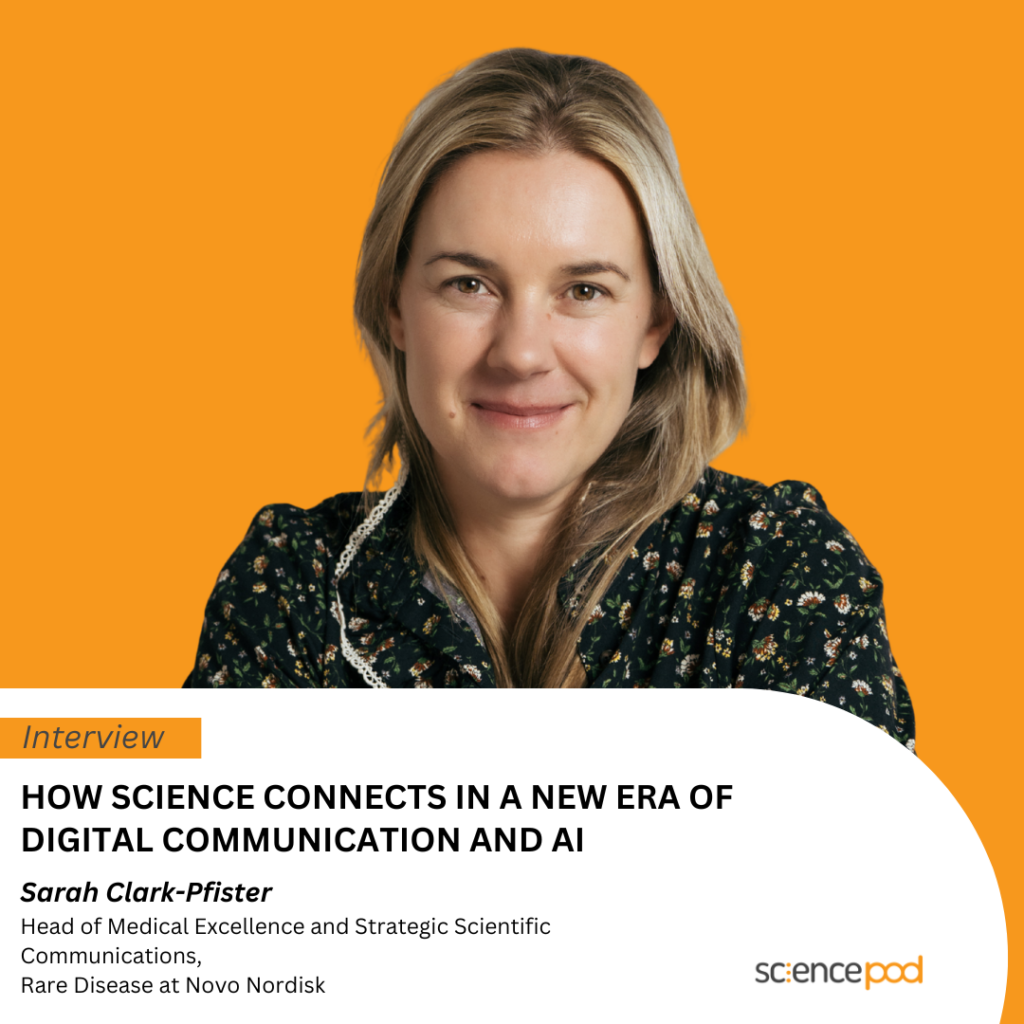
Interview with Sarah Clark-Pfister, Head of Medical Excellence and Strategic Scientific Communications, Rare Disease at Novo Nordisk
The dynamics of engagement with healthcare professionals are shifting rapidly, but the importance of clarity in scientific messaging remains crucial. This is one of the insights Clark-Pfister shares in an interview with Sabine Louët, SciencePOD founder.
Clark-Pfister will be speaking at the NEXT ‘26 Pharma Summit, 19-20 May 2026, Dubrovnik in a session exploring The Power Behind the D: Who Shapes It, Who Drives It, Who Delivers It? Treatment Decisions in an MFN World.
Could you give us your perspective on how digital, and specifically AI, is changing your communication strategy and how you are adapting?
The first point I’d make is that digital is a core part of amplifying how we communicate our scientific content and make sure that the science we’ve developed and invested in, alongside patients and clinicians, translates into something real for the clinical community, transforms care and ultimately patient outcomes. Digital is how science reaches scale, but only if our message is clear.
The second point is that things are changing quickly. I heard on a recent webinar that over 200 million health queries are made to LLMs weekly, and 7 out of 10 queries are outside clinic hours. Patients are using LLMs at diagnosis and treatment decision points. So, whilst we talk about amplifying our message and being clear on what our scientific content looks like, we also have to keep in mind that there is a fundamental behavioural shift, and we now have a new type of stakeholder.
Adapting to this is a top priority for us. As an example, we’ve partnered with OpenAI and are exploring how to use LLMs across the full value chain: from drug discovery to supply chain to commercial operations. The use of AI in communications is just one component of this broader transformation. It’s special to be a part of something like this.
What about changes on the market access side?
There’s a huge amount of change in the industry. One catalyst for change is the ‘Most Favoured Nation’ (MFN) drug pricing policy of the U.S, which is potentially creating links between ex-U.S. and other major markets from a pricing perspective. This might influence launch timing and indication sequencing decisions. It also increases the need for robust evidence because of the change from a price-based to a value-based discussion.
From a digital engagement model perspective, this is a second-order impact. Your sequence of launch countries might differ. You might need to focus on different populations and in a different order than previously, thus impacting content adaptation and utilisation. We may see a difference across standards of care, treatment pathways and launch timing for new medicines, at least in the intermediate term. When launches fragment, engagement fragments as well, digital then becomes an essential system to manage this complexity.
What role do you think technology will have in addressing new challenges, in the previously mentioned context of LLM use, for example?
I think technology will be a fundamental tool. If we think about something like the evidence construct that is needed to move away from a price-based to a value-based discussion, I think the medicines with the strongest value narrative are the ones that will succeed.
Technology is turning data into evidence and evidence into value narratives. For instance, consider the work happening in understanding patient quality of life, patient daily life activities, impact on society. We have the opportunity to reach a much deeper understanding of disease pathology and how a medicine can change a patient’s life.
We may be at an inflection point where healthcare systems data has matured, digital technology has matured, and LLMs are unlocking amazing opportunities to do something with the data. How companies manage to translate this moment into something that’s a ‘differentiator’ will define which companies come out ahead in the foreseeable future. We are in a moment where pharma is and should look different.
What does this mean for communicating science developments to healthcare professionals?
The core truth remains: You absolutely need to have a crisp scientific narrative and science that’s understandable. Whether your stakeholder is an LLM or a healthcare professional, whether you’re delivering a message face-to-face or through digital channels, the essence remains. Your communication has to be very clear as it goes up against a huge volume of potential noise. Harnessing clarity in strategic communication is key.
The views expressed in this interview are the speaker’s own.
This Interview has been edited for clarity and length.