
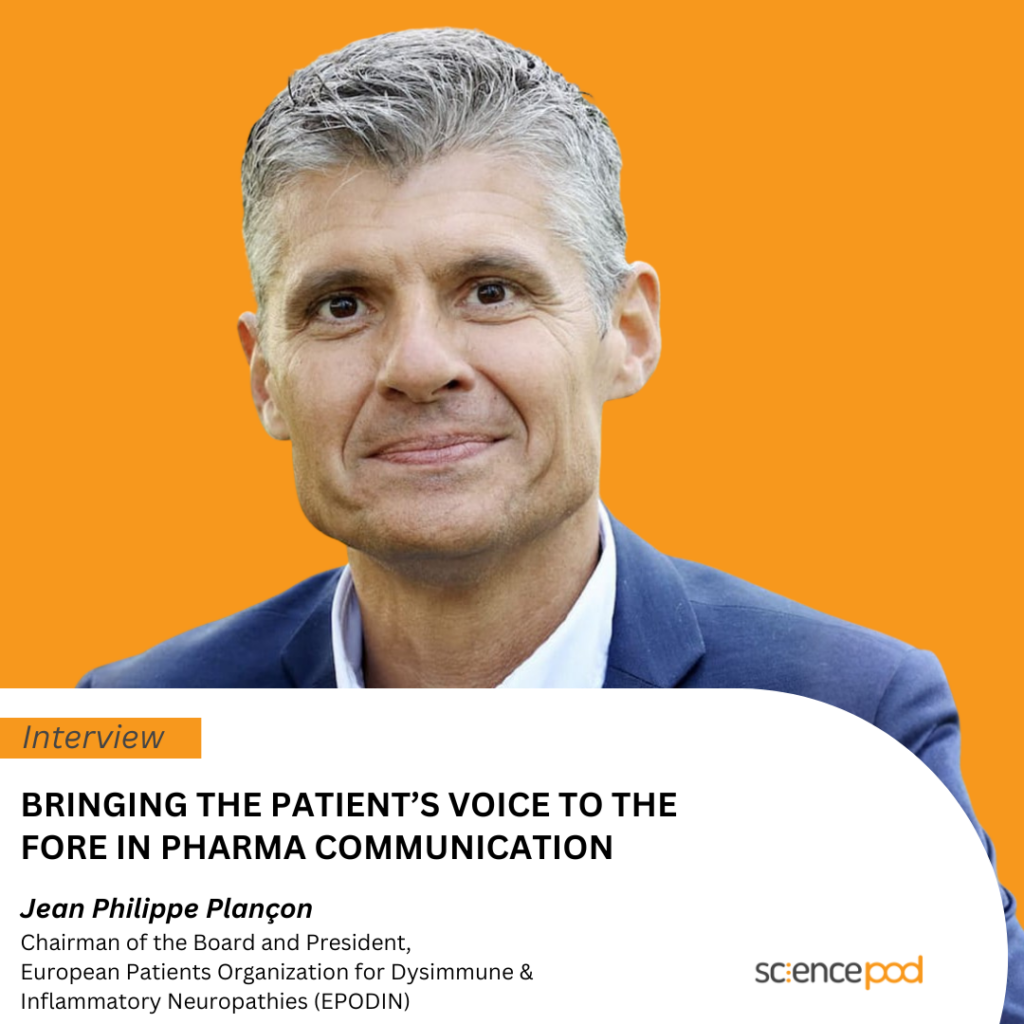
Interview with Jean‑Philippe Plançon, Chairman of the Board and President, European Patients Organization for Dysimmune & Inflammatory Neuropathies (EPODIN)
As the president of a patient advocacy organisation and a patient himself, Jean-Philippe Plançon is in a unique position to provide insights into what patient-centric and patient-driven initiatives mean.
In this exclusive interview with SciencePOD founder Sabine Louët, Plançon discusses the importance of transparency, patient-sourced data, communication, and patient input into healthcare and policy.
Plançon will dive deeper into these topics at Reuters Events Pharma 2026 in Barcelona on 22-24 April, where he is participating in the Case Study session titled Bridge the conversation gap: Enable seamless HCP-patient dialogue. The session will be moderated by Sabine Louët.
Would you tell us about your current role and EPODIN?
I am the President of EPODIN. We represent people living with rare neuro immunological conditions, rare diseases such as Guillain-Barré syndrome, chronic inflammatory demyelinating polyneuropathy (CIDP), Multifocal Motor Neuropathy (MMN) and related disorders. And I’m a patient myself; I’ve been living with dysimmune & inflammatory neuropathy for more than 25 years now.
So, you are perhaps in the best position to talk about this: What is your perspective on the role of digital communication, specifically regarding how patients access relevant medical information about rare diseases?
I would say that digital communication is essential, particularly for rare diseases, including inflammatory neuropathies. As you may know, for rare diseases, expertise is often fragmented. So, for us as patients, digital communication is not just a channel, it is an access tool that can connect patients to reliable information. It helps overcome geographic, language and knowledge barriers. We could say that it reduces isolation.
What’s your view on pharma’s role in digital engagement of patients and patient organisations?
I think pharma can play a key role, but engagement with patients and patient organisations needs to be relevant and take place early, continuously and collaboratively. Often, solutions are designed for patients rather than with patients, I think it’s important to co-create.
I would add that trust is crucial, fundamental; it’s important to have clear communication around consent, data use and privacy. Patients and patient organisations need to know what data is collected, why and how it’s used, and what safeguards are involved.
I have acted as a reviewer for clinical trials and patient consent documentation at INSERM, France’s leading public institution for medical and health research. Over the past decade, I have witnessed significant improvements in this area. However, consent forms are still complicated and difficult for patients to understand. This is an area we can still improve on; we need to ensure patients can fully understand what they are consenting to in a clinical trial, for example.
The regulatory framework is appropriately rigorous. However, it requires sufficient time and clear explanation to ensure proper understanding; it cannot be reduced to a form being signed in a minute at the corner of a desk. Patients must be given clear, accessible, and comprehensive information regarding the purpose of the clinical trial and the nature of their consent.
With this in mind, could you give some examples of initiatives that have contributed towards greater levels of transparency?
Within EPODIN, we have developed a patient-driven, real-world evidence data platform to address the lack of data on rare diseases and to better understand their burden. The aim is to generate patient-centred insights into disease burden, treatment impact, and daily life.
This platform is patient-driven, created by patients for patients. I would describe it as a 100% patient-driven, real-world evidence data platform. It captures burden of disease information and covers topics such as quality of life, fatigue, work impact and mental health, while also ensuring full GDPR compliance. The platform is also multilingual, which is crucial for patient access.
What are the goals of this initiative? What do you hope to achieve?
An important objective of this real-world evidence platform is to address the lack of data on rare diseases, such as dysimmune inflammatory neuropathies, and to better understand their burden. What distinguishes this initiative is its patient-driven design, enabling the collection of relevant, real-life insights directly from patients.
By capturing the full patient journey from diagnosis through treatment to long-term follow-up, the platform provides a comprehensive view of treatment burden, effectiveness, and limitations in real-world settings.
Through the collection of robust, community-level data, we aim to generate evidence that can inform clinicians and policymakers, support clinical decision-making, and contribute to regulatory processes, ensuring that patients’ needs are appropriately reflected.
The views expressed in this interview are the speaker’s own.
This Interview has been edited for clarity and length.