
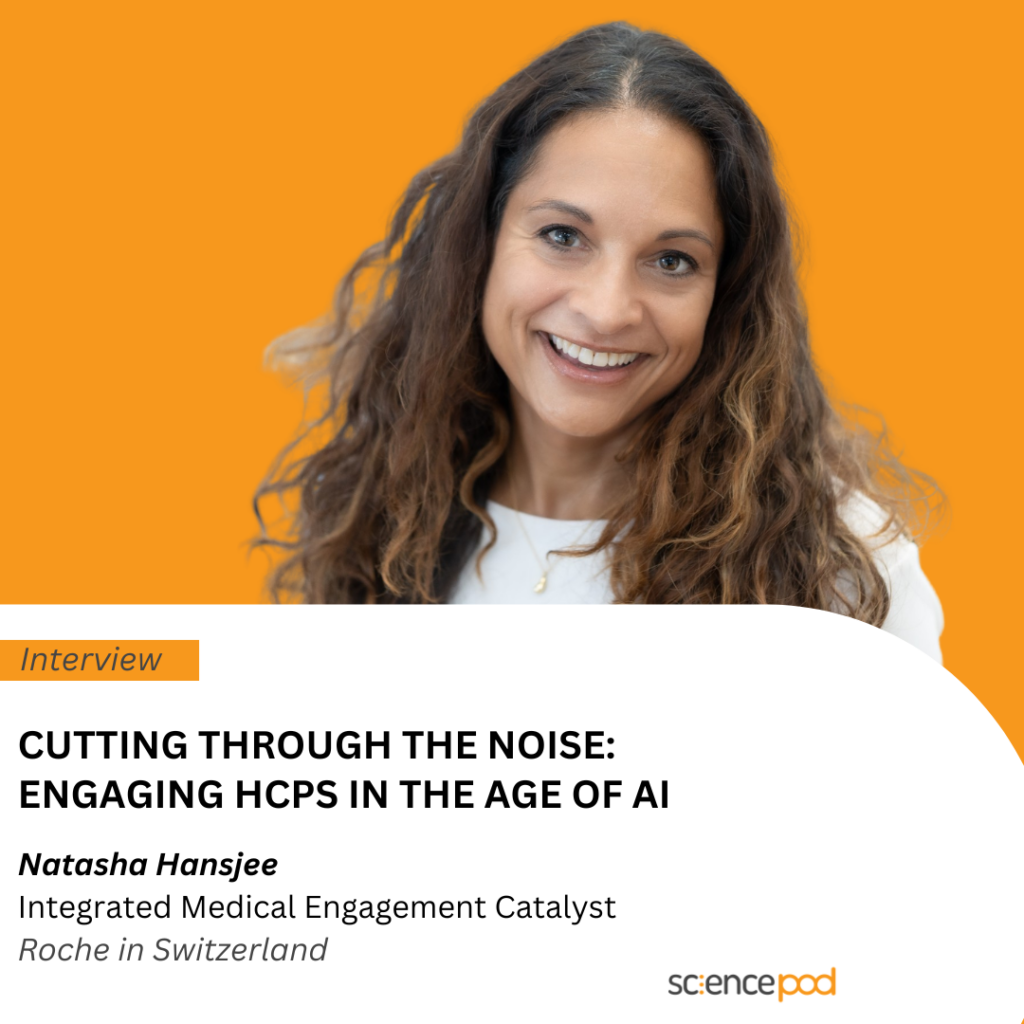
Interview with Natasha Hansjee, Integrated Medical Engagement Catalyst at Roche in Switzerland
As AI tools reshape pharma communications, Hansjee argues that meaningful engagement with HCPs depends on relevance, pragmatism, and keeping the human element at the centre.
How can the pharmaceutical industry use AI to engage HCPs more meaningfully? According to Hansjee, the answer lies in pragmatism, focusing on real problems, and using technology to deliver relevant information to HCPs.
In this interview, Hansjee shares lessons from her experience; she will expand on these themes in her keynote, ‘Meaningful Outcomes in Pharma: Advancing Customer Engagement and Conquering Misinformation,’ at the 2nd Pharma Meets AI Conference in Barcelona on 20–21 April 2026.
SciencePOD founder Sabine Louët spoke with Natasha Hansjee ahead of the conference about digital engagement, AI, and how pharma can connect more effectively with HCPs.
Your title, Integrated Medical Engagement Catalyst, is unusual. What does the role involve?
Think of me as the spark that ignites meaningful connections at Roche. My role allows me to connect medical and commercial teams, a link between science and people.
I look for gaps – where things are missing or not working as well as they could – and bring together the right people, tools, and ideas to bridge them. I catalyse by connecting people so that meaningful engagement can happen.
Can you share an example of a digital initiative you are particularly proud of?
One example comes from the COVID-19 pandemic, when we needed to maintain educational engagement with HCPs. We initiated “tweetorials”, online medical education on social media where experts shared insights and interacted in real time. They sparked conversations with multiple customers, including digital opinion leaders we might not otherwise have connected with. The project taught us a lot. We learned to navigate digital spaces and test what these tools could realistically achieve. It also showed us how digital communities interact and the value of online exchanges like these.
AI tools are evolving rapidly. How do you decide which technologies are worth adopting?
We always start with the need. What do our key customers – HCPs and patients – need from us? How can we best serve their needs?
Social media and AI create opportunities as well as risks. How do you manage that balance?
I’m very enthusiastic about AI and digital innovation, but I’m also aware of the risks. These technologies can spread information quickly, but they can also amplify misinformation. That is why governance and compliance are essential in our industry. The same applies to any other pharma company.
How important is the human factor when introducing new technologies?
It is essential. Technology does not implement itself. Every new tool requires behavioural change, and that takes time. If organisations constantly introduce new systems, people quickly become overwhelmed. But if we build on tools they already know and trust, it becomes much easier to adopt innovation. Technology can help us work more efficiently and should support meaningful exchanges, not replace them. Even with powerful digital tools and AI, trust and genuine dialogue between people are essential because healthcare is a human undertaking. At the rate at which new AI tools are being launched, it can be overwhelming but equally exciting.
What are the biggest challenges today in engaging HCPs?
There is simply too much noise. HCPs are overwhelmed. HCPs receive a constant stream of information and requests for their attention. As an industry, we need to step back and focus on the quality of engagement rather than the quantity. We also need to better understand the information HCPs need.
Looking ahead, what would you most like to see change?
I would like to see clearer and more meaningful interactions between pharma and HCPs. In the past, there was often more time for genuine conversations – moments where discussions could create real human connections. Today, many interactions are tightly scheduled.
Technology should help us cut through the noise, restore relevance, and provide more time for human interactions. If we can provide information that truly matters to HCPs and respect their time, we can rebuild those meaningful exchanges.
The views expressed in this interview are the speaker’s own.
Interview conducted by Sabine Louët. Edited from the interview transcript for clarity and length.