

How a global pharmaceutical company combined disease awareness content with HCP lead generation
Most pharma web content asks readers to sign up and log in before offering them anything. This case study describes a project that reversed that logic. A global pharmaceutical company worked with SciencePOD to produce open, unbranded disease awareness content that served the public first, and in doing so, drew healthcare professionals towards deeper engagement on a gated portal.
The challenge
Pharma teams widely recognise the need to build a digital presence. However, the practicalities often prove difficult. Content must satisfy medical, legal and regulatory (MLR) review, be strictly scientifically accurate, and still be engaging enough to hold the attention of time-pressed readers. MLR review is one of the most cited barriers when it comes to creating digital content. If the content arrives poorly referenced or loosely worded, it tends to stall during MLR review.
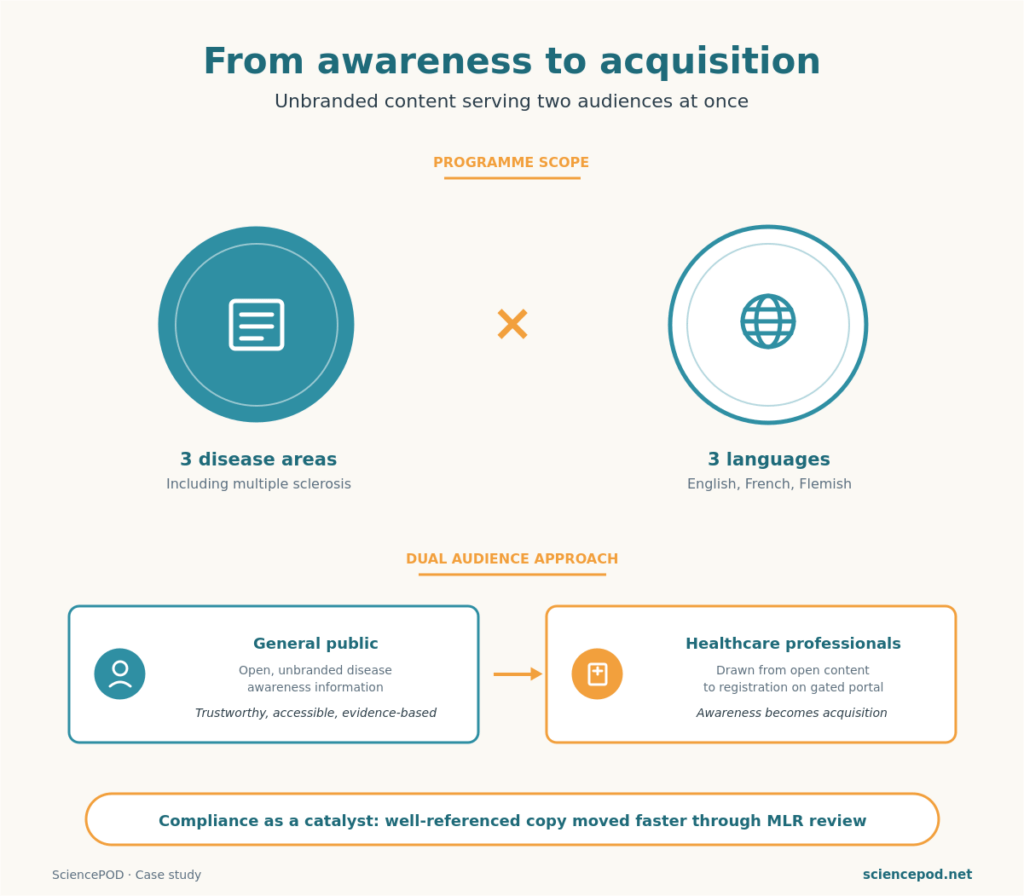
The client faced an additional layer of complexity. They wanted to raise awareness across three disease areas for a Belgian audience, which meant producing every piece of content in English, French and Flemish. The content had to be unbranded, with no reference to specific products or treatments, and had to work for two audiences at once: members of the public seeking trustworthy information, and the healthcare professionals (HCPs) the client aimed to bring to its portal.
The solution and approach
SciencePOD provided the medical copy for web pages covering three disease areas, including content mapping the patient therapeutic journey, delivered in all three languages. The writing translated complex medical information into concise, evidence-based copy that a general reader could navigate easily without sacrificing the rigour an HCP expects.
Each page followed a consistent five-section structure, including a dedicated question section. This served two purposes – engaging readers directly, as well as improving the content’s relevance for search engines and generative engine optimisation (GEO), increasing the likelihood of the pages being surfaced and cited by AI-driven search tools.
Every claim was anchored in scientific evidence and fully referenced. This discipline paid off at review, as the copy arrived at MLR well-sourced and precisely worded. The review process ran smoothly and quickly, facilitating timely publishing.
The results
Early analytics from the pilot, drawn from one of the disease area hubs covering multiple sclerosis, indicate that the approach is working. Engagement rates exceeded 90% across the content pages, and the strongest pages held readers for more than a minute on average, a solid dwell time for medical web content.
The pages also performed well as entry points. Bounce rates on the main landing pages sat below 20%, indicating that